
In order to better explain the concepts related to the underground water market, it is first necessary to review some other related concepts.

The status of underground water in Iran:
Our beloved country, Iran, is located in an arid and semi-arid climate. The average annual precipitation in the country is 250 millimeters. This means that throughout history, we have always faced water scarcity, and adapting to this scarcity has been a necessity for our ancestors. As their heirs, we also face the challenge of water scarcity. Except for a few areas of the country with adequate rainfall and permanent rivers, most provinces do not have stable surface water resources. Therefore, the use of groundwater through wells has become the primary means of accessing sustainable water resources in most provinces. The annual water consumption from water resources in the country is 98 billion cubic meters, with approximately 60% of it coming from groundwater sources (wells and qanats).
The status of the plains in the country in terms of water consumption:
A plain or aquifer refers to the porous groundwater table, or more simply, the permeable structure made up of various types of rocks, within which water is present. In water resource management terminology, the term "plain" is used interchangeably with "aquifer." To simplify the concept, an aquifer can be described as a bowl-shaped structure beneath the ground, composed of rock formations and water. By relying on sciences such as geomorphology, hydrogeomorphology, and other related disciplines, the dimensions and common boundaries of these "bowls" can be determined. In our country, according to conducted assessments, there are 612 plains. Unfortunately, due to excessive extraction and the decline of groundwater levels, 410 of these plains are classified as "forbidden." A forbidden plain refers to a plain where water extraction exceeds the allowed limits. Declaring a plain as forbidden means that, except for drinking water, drilling new wells for other uses of groundwater will no longer be permitted. However, over the past few decades, this regulation has not been fully enforced, and in many plains, drilling and extracting water from wells has continued even after they were declared forbidden.
The status of agriculture in Iran in terms of water consumption:
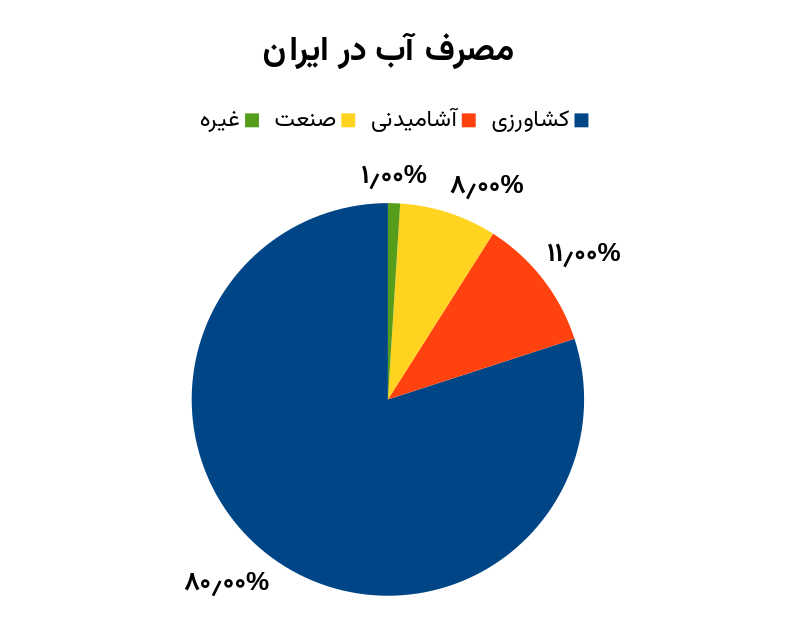
Various organizations provide different statistics regarding water consumption in the agricultural, industrial, drinking, and services sectors, and the figures may vary slightly. According to available documents, approximately 80% of water resources are consumed in agriculture, 11-12% in drinking and services, and 8-9% in industry. Therefore, the largest consumer of water in the country is the agricultural sector. Additionally, the water use efficiency (productivity) in agriculture in Iran is 30-40%, which is half of the global average. On the other hand, 25-35% of agricultural products produced, from planting to household consumption, become waste. As a result, it can be concluded that the water use efficiency in the agricultural sector in the country is very low. It is also worth noting that water use efficiency in other sectors is not clearly defined. However, due to the high share of agriculture in the total available water resources, this sector plays a more significant role in water consumption.
The status of development in Iran:
Iran's population was approximately 36 million in 1979, and by 2023, it has reached over 85 million. The more than two-fold increase in population in less than half a century has made the need for development a top priority in Iran. The first step in development is ensuring access to sustainable water resources. As the population grows, industrial, agricultural, and service activities have increased, putting more pressure on water resources. For example, agricultural production has risen from about 25 million tons in 1977 to over 120 million tons.
Underground Water Market
As mentioned in previous sections of this article, access to water resources in most provinces of the country is through the use of groundwater. It was also noted that more than 60% of the country's plains have been declared forbidden, and drilling new wells (except for drinking purposes) is not permitted. Now, we face the question of what should be done for the development of the country, given the aforementioned limitations? The first step is to acknowledge the limitation of water resources. The aquifer, around which the agricultural, industrial, drinking, and service sectors are centered, will not expand. Therefore, any change in the water allocation for each of these sectors must be achieved through inter-sectoral transfer. Water transfer projects, such as those transferring water from the Oman Sea and the Persian Gulf, are not considered new sources of water for technical reasons. To better understand the underground water market, it is essential to first become familiar with the following concepts:
- Well: A location where groundwater extraction takes place.
- Exploitation License: A document issued by provincial water companies for each well, containing important information such as the well's yield (discharge rate), the allowed annual extraction volume, permissible operating hours per year, details of the well’s users, and the consumption pattern. The consumption pattern depends on the type of use. For example, the exploitation license for a well used by a steel manufacturing plant includes the production volume of steel products, while the exploitation license for agriculture provides information on crop patterns, types of crops, and the quantity of agricultural products grown.
- User: Individuals or legal entities who have been issued an exploitation license and are authorized to use the well.
- Water Meter: A measuring device that records and stores the water consumption data of each well.
The Underground Water Market Project by Zist Ab Poraab Company
Each well is equipped with a smart meter that measures the water consumption of the well. In regions where the underground water market is implemented, the smart meters must be capable of accepting a smart water share card.
The smart card operates similarly to common fuel cards. On fuel cards, the monthly fuel allocation for each vehicle owner is displayed, and when the owner refuels at a gas station, the fuel card is inserted into the device, and the amount of fuel dispensed is calculated. If the amount of fuel exceeds the owner's permitted share, the fuel pump automatically shuts off.
In the case of groundwater extraction, the smart water share card is inserted into the smart meter, and the water pump is activated. The amount of water extracted from the well is calculated by the smart meter. If the amount of water extracted exceeds the allocated share on the smart card, the pump will stop, preventing any over-extraction.
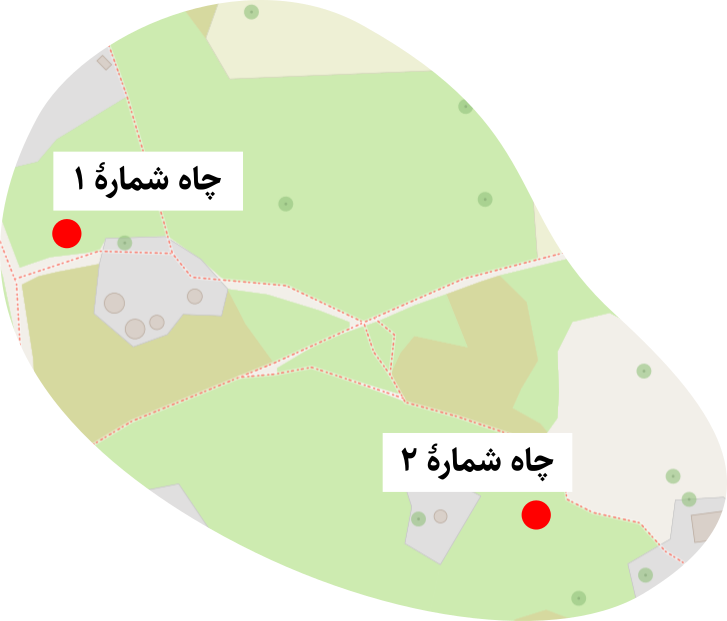
According to the diagram below, let's assume there are two wells in a plain. Well number 1 is used for agricultural purposes and has an annual allocation of 300,000 cubic meters of water. Well number 2 is used for industrial purposes and has an annual allocation of 80,000 cubic meters of water. Both wells are in operation and consuming water throughout the year. If the farmers using well number 1 extract water and use it for agricultural purposes to produce the crops specified in their exploitation license, while simultaneously optimizing water use, they may transfer excess water to the user of well number 2, which consumes more water but doesn't have enough allocated share. Suppose the users of well number 1 have consumed 280,000 cubic meters of water and have 20,000 cubic meters of surplus water. On the other hand, the users of well number 2 have consumed their full 80,000 cubic meters but still need more water. Therefore, they can purchase the 20,000 cubic meters of water from well number 1. The term transfer refers to the movement of surplus water from the smart card of well number 1 to the smart card of well number 2, followed by the physical extraction of the water from the same well location.
The Water Market Project in Khorasan province, specifically in the Khaf plain, was launched in 2021 as the first national pilot project. After observing its positive results, the project has continued to progress. Following this, the establishment of the water market in Qazvin province was initiated and is currently in operation. Additionally, the water market project in Semnan province has been under implementation since the summer of 2023.

